50
Put My Fuckin’ Dinner on the Plate, and Keep Your Mouth Shut
Written by Robin Green & Mitchell Burgess
Directed by Allen Coulter
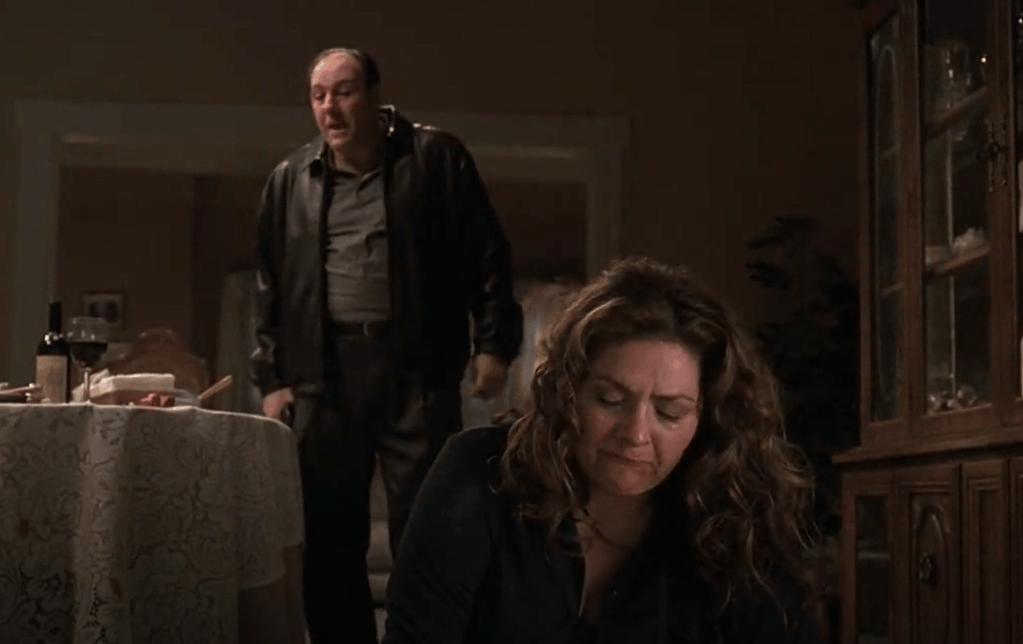
Janice kills Richie, Carmela suspiciously listens as Janice calls Tony in a panic, and Tony reacts to a pleasant surprise.
_______________________________
I’ll cheat and split the series’ biggest shock value moment into three scenes: Janice shooting Richie, Janice’s subsequent phone call to Tony, and Tony’s discovery of Richie’s bloody corpse. Richie Aprile, along with Phil Leotardo, is the show’s most homophobic character (which says a lot in the company of Paulie and Carlo, among others). All the signs point to Richie keeping company with men in the can, heightening his homophobia. Richie, who had no options besides men during his ten-year stint, resents his gay son who chooses men despite the freedom to choose women.
When Janice pushes these buttons, Richie, with his wedding on the horizon, does exactly what he warned Christopher not to do: “You wanna raise your hands, you give her your last name.” Following Richie’s square punch to Janice’s face, she draws a pistol, and Richie remains as unconvinced as the audience that his fiancée will pull the trigger. “Get the fuck outta here, i’m in no mood for-”. In a split second, Janice proves she’s unlike Carmela, Adriana, Rosalie, Angie, or any other Sopranos woman. She doesn’t take any shit.
The Soprano house phone rings, and Carmela, in arguably her funniest line of the series, snarls, “You better get it, maybe she slit the other wrist,” following Tony’s attempt to use Irina’s post-suicide attempt phone call to the house to evoke sympathy from Carmela.
Tony then arrives at his mother’s and readies his gun, only to find a pleasant surprise that prompts a gloating smile. With Janice deliriously smoking a cigarette, it’s easy to miss Tony’s reaction, but it sure is priceless.
49
It’s a nice example he sets for his son
Written by Lawrence Konner
Directed by Tim Van Patten
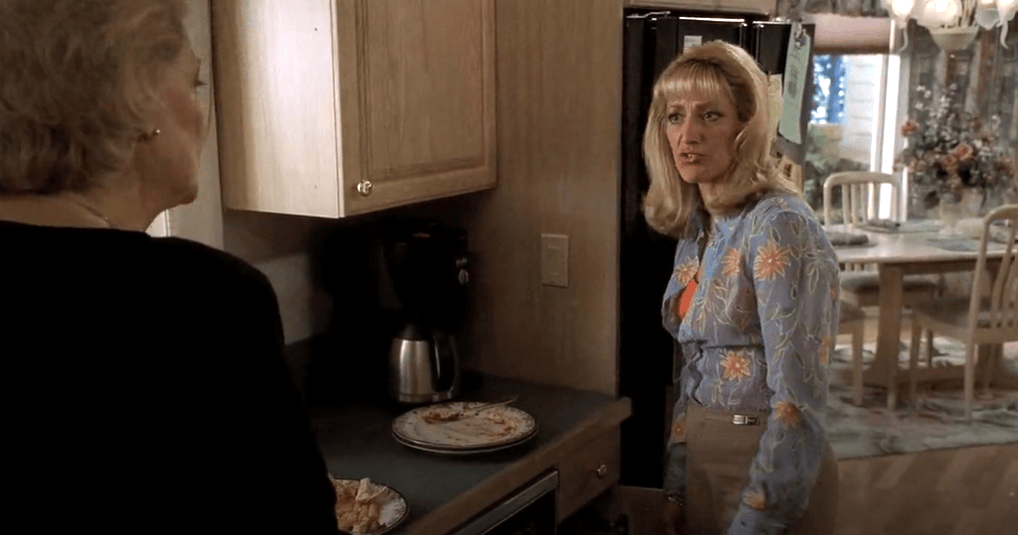
Mary justifiably judges her daughter’s marriage, forcing Carmela to self-reflect.
_______________________________
We’ve heard Mary’s opinion on Livia before, but now, we finally see how she really feels about Tony. Of course, her distaste toward Tony has nothing to do with the Mafia. But she, unlike her husband, does recognize Tony’s a lousy family man. When Carmela requests a zoned-out Tony to help parent AJ, Mary glares at her son-in-law, impatiently waiting for him to step up and be a dad. When Tony leaves Sunday dinner to deal with “problems at work,” Mary rejects her grandson’s request to follow suit and be excused, only for Carmela to bail him out so he can finish homework before his DC trip (homework that, mind you, can’t possibly be his reason to leave the dinner table). “Second Opinion,” a top 5 episode, focuses on Carmela’s evaluation of her marriage to and future with Tony:
- She runs into Angie at the supermarket and learns Tony has Angie on his payroll, and surmises Angie isn’t the only widow Tony financially supports. Tony will send money to Angie, but refuses to donate $50,000 to his daughter’s university.
- Carmela, trapped by Tony, contemplates her lack of fulfillment by contrasting her independence (or lack thereof) with Meadow’s. Meadow has the world at her fingertips as she thrives at Columbia, destined for a successful career and marriage to a man who couldn’t possibly be as domineering as Tony.
- She visits Dr. Krakower, who demands she must leave Tony at all costs.
So, the fact that Carmela has “gotta hear this Angelo Stamfa shit again” from Mary (after confessing she and Tony have been attending therapy together) is the perfect way to begin the episode. In her defensive retort to Mary’s suggestion that Angelo Stamfa would’ve been a preferable life partner since he A) wouldn’t be a grouchy mope who’d require therapy and B) could provide thanks to his drug store chain, Carmela hilariously spits “So what, he doesn’t need therapy? He prescribes his own tranquilizahs?” I mean, no matter how awful Tony is or how much Carmela chooses to look the other way, you can’t blame Carmela for blowing up when her mother says “he’s no Angelo Stamfa, that’s all”.
The argument migrates to the kitchen, where Carmela labels Mary’s concern for her marriage as hypocritical, considering Mary and Hugh benefit from Tony’s connections. When Mary reminds her daughter that she too reaps the benefits of Tony’s power, Carmela skips no beats with “I earn it. You two get a free pass.” At face value, this response sounds like the typical rewards of being a housewife: raise the kids and cook dinner, get jewelry and a 6,000 square foot house in return. But, upon closer look, she endures a toxic, depressing marriage (AND existence) to “earn” a superficially glamorous lifestyle.
Additional Notes
- Hugh groans “That’s all they have at King’s these days. Balsamic, balsamic, balsamic. My mother never heard of balsamic.” This show highlights generational change, and it’s refreshing to hear an “elderly” perspective from someone besides Phil, Junior, or Livia.
- AJ taunts Tony by mentioning he’s visiting FBI headquarters during his DC trip. While AJ knows that his dad and the FBI are adversaries, he surely doesn’t realize to what degree the FBI affects Tony.
- A preoccupied Tony scarfing chicken while Carmela requests his assistance to get stern with AJ is a poetic display of how low “be a father” is on his list of priorities.
- We never hear Tony or Mary express explicit animosity toward one another. But, on top of everything else, the animosity (or at the very least, indifference) is clear as ever when Tony says goodbye to Hugh, and nothing to Mary.
- Based on Mary’s facial expression regarding Carmela’s therapy confession, she likely opposes therapy just as much as Livia. Mary just channels her disapproval in a less obnoxious (and deadly) manner.
- We never learn why Tony had to leave dinner, because it’s irrelevant to the plot and characters. Typically, you’d expect to learn what Tony’s emergency was. But, as usual, The Sopranos decides not to give us answers we mistakenly think we need. It’s just a standard display of the regularness of life.
48
I’m glad we have that kind of relationship
Written by James Manos Jr.
Directed by Allen Coulter
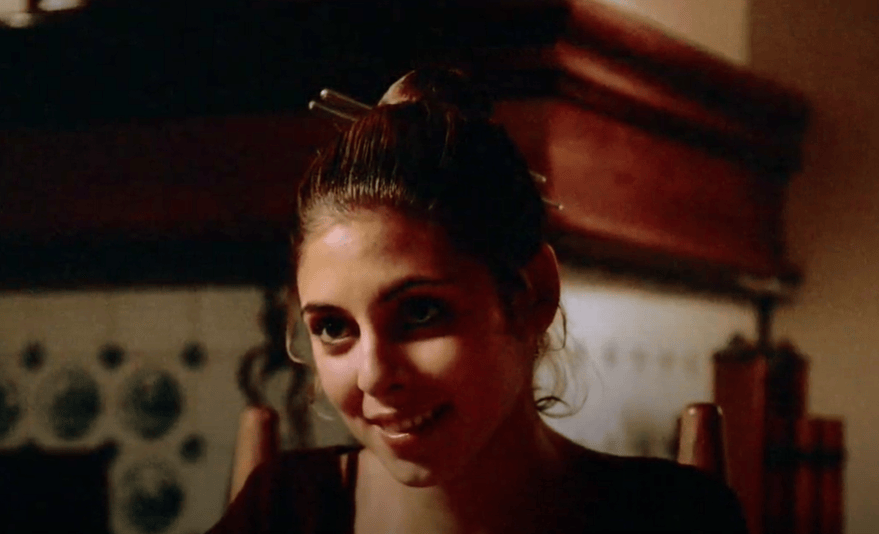
Tony and Meadow’s bond shines in full effect
_______________________________
One of the most beautiful scenes in the series (and by default, television history). Following a quick cut from Carmela’s complaint to Father Phil of “he doesn’t have time to talk to me for two lousy minutes,” the scene aims to capture Meadow as angelic:
- Michael Hoppe’s elegant cello plays “Gold Leaves” to enhance the grace of father and daughter’s tenderness.
- He silently and adoringly gazes at Meadow (“Dad stop staring. Why are you doing that?”… “And she looks like one of the models out of Italian vogue”). Tony’s adoration of his daughter contrasts the aforementioned neglect for his wife.
- The lighting and camera angles leave Tony’s face shadowed and dark, while Meadow’s glistens.
These stylistic choices, along with the remainder of their dinner, establish the foundation for Tony Soprano the father. The only pure love Tony has is for Meadow. It goes without saying his love for AJ is not pure, and he surely loves Carmela and appreciates her…when he wants to. That being said, parenting finds itself at the bottom of Tony’s priorities.
After Meadow shares she used meth for SAT studying, Tony becomes a disciplinarian for no more than thirty seconds. Soon enough, the audience realizes Meadow, a teenage meth abuser, has more power than her father, a mob boss, when Tony promptly surrenders his authority and transitions to a tender exchange about their newfound relationship built on honesty. It’s a classic instance of Soprano parenting; yell for ten seconds and come across as domineering, and quickly forget it ever happened.
Then, he all but forces his daughter, a junior in high school and now a candidate for drug addiction, to go out with college girls (only to down shooters and black out). Later in the dinner, when Meadow says “I’m glad we have that kind of relationship,” the camera cuts to Tony with guilt flooding his face. This is nearly identical to Tony’s reaction in the “are you in the Mafia?” scene when Meadow says “you finally told the truth about this” just ten minutes prior.
Throughout Season 1, particularly in “College” and the prior episode, “Meadowlands,” Tony navigates guilt as he shields the truth from his children. As they age, both kids, particularly Meadow, relieve Tony of this burden as “I’m glad we have that kind of relationship” gradually becomes denial and rationalization. Tony’s grooming of Meadow’s rationalization and denial begins right here at this restaurant in Maine: “You know, there was a time, Mead, when the Italian people didn’t have a lot of options.” Meadow spits this exact logic back to Finn in Season 5’s “Unidentified Black Males.”
Additional Notes
- The conversation highlights one of Tony’s only simple pleasures (besides eating): history. Tony reveals he was interested in history during his semester and a half at Seton Hall, and for the remainder of the series, Tony regularly watches the History Channel.
- “It was just between homework and SATs and the general pressure of life…we needed something to keep going” serves as Meadow’s excuse for doing meth. This poetically parallels Tony’s comment seconds earlier: “Maybe being a rebel in my family would’ve been selling patio furniture on Route 22.” When you view this in the same lens as Christopher’s “I don’t know Tony, it’s like just the fuckin’ regularness of life is too fuckin’ hard for me or something, I don’t- I don’t know,” we are reminded of one of the Sopranos’ central, central themes. These characters, including Meadow (beginning with meth and ending with representing white collar fraud clients) need an extra thrill or two for life to be tolerable.
- I enjoy the theory (rooted in little more than symbolism) of Meadow as Tony’s guardian angel. As mentioned earlier, the scene’s stylistic choices paint Meadow as an angel in Tony’s eyes. Later in the episode, Febby Petrulio spares Tony thanks to Meadow’s mere presence outside the motel room. Six seasons later, if you choose to believe Tony was shot on the cut to black, Meadow was likely a centimeter away from fully entering the diner. Had Meadow been a millisecond earlier and completely inside the diner, her role as Tony’s guardian angel would’ve/could’ve saved Tony. Also, she rescues Kevin Finnerty from hell and pulls him out of purgatory during Season 6’s “Mayham.”
- Circling back to Tony’s impure love for Carmela, think about when Ralph made the Ginny Sack joke. Did John, the most egotistical character in the show, seek revenge on Ralph out of pride? Or, was it a combination of both ego and love for his wife? How about when Coco harassed Meadow? If an inappropriate joke was made about Carmela, Tony would primarily seek revenge solely out of pride, rather than out of genuine love for Carmela.
47
You need to learn to shut stuff out
Written by: Terence Winter
Directed by: Tim Van Patten
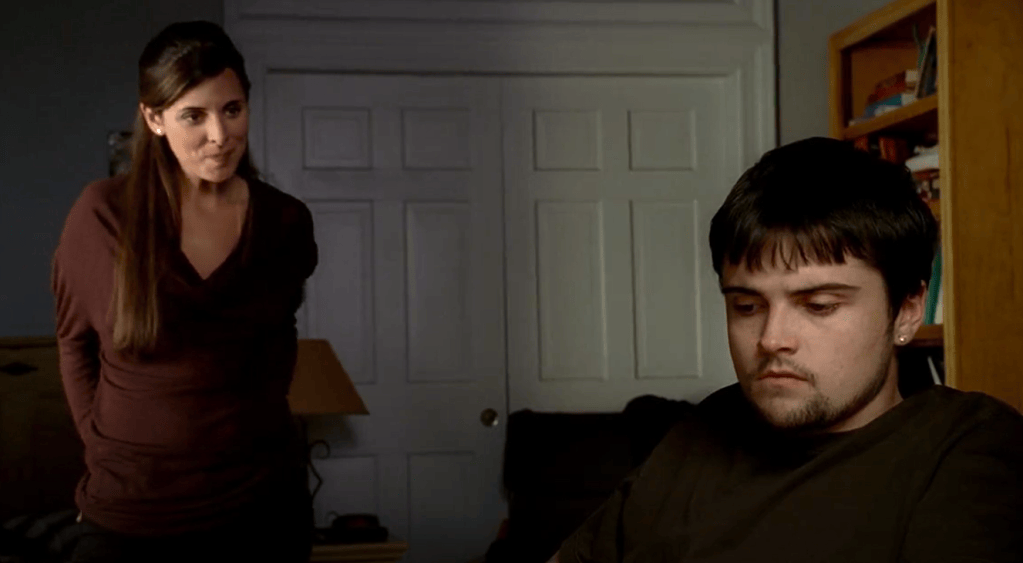
Meadow tries to comfort AJ right before he attempts suicide.
_______________________________
Meadow, cognizant of AJ’s suicidal tendencies unlike her parents, attempts to comfort and help her brother as he begins to display worrisome signs. The Jasons’ recent attacks on Victor the gambler and the Somalian student left a harrowing mark on AJ, plummeting him back into a depressive state. Next thing you know, AJ’s bemoaning to Meadow about Bush’s prospective bombing of Iran. Evidently, AJ’s pacifism induces this wave of depression.
Meadow’s “you need to learn to shut stuff out” is solid advice in a vacuum, but means much more when contextualized according to the show’s commentary. Ever since her “Mr. Mob Boss” confrontation in “No Show,” Meadow has learned to shut out…and rationalize…Tony’s evil. Conversely, AJ cannot overlook violence or disharmony. Thus, he’s forced to juggle the love he desperately craves from Tony with the understanding that the Jasons’ predatory pursuits are amateurish relative to his own father’s.
When AJ reveals he feels his parents have always favored Meadow, she replies, “We’re Italian, AJ. You’re their son. Do you have any idea what that means? You’ll always be more important.” While there may be some truth to this Italian stereotype, it holds no weight in the Soprano household. Carmela and Tony have treated Meadow as their pet because they could show off her and her Ivy League diploma, and she was (relatively) easy to parent. Meanwhile, parenting AJ has been a hardship (and thus he was hardly parented at all), and his parents are ashamed of him.
AJ, ever his grandmother’s grandson, dismally speculates, “Don’t you ever feel like there’s no point to any of this?” all while his stereo plays “Into the Ocean,” a song about the lead singer’s battles with depression and suicidal impulses. AJ Soprano is a deeply tormented soul, and his storyline is of paramount importance in The Sopranos’ final season as he struggles to cope with the reality of his father’s violent nature. Later in the day, AJ covers his face with a plastic bag, ties a cinderblock to his ankle, and jumps in his family pool.
46
“Oh my God, she’s so dark!”
Written by: Michael Imperioli
Directed by: John Patterson
Carmela leverages her mother’s shame to crawl back to Tony.
_______________________________
Identity crisis is a central theme throughout the series, particularly among Tony, Carmela, AJ, Christopher, and Melfi. Here, we learn that Carmela’s mother, Mary (whose family probably hails from Northern Italy), detests the rambunctiousness of the less civilized/cultured descendants of Southern Italy. The disparity is apparent: Tony with the “off-color jokes, the sausage twirling,” and Dr. Fegoli with his international affairs doctorate from Princeton.
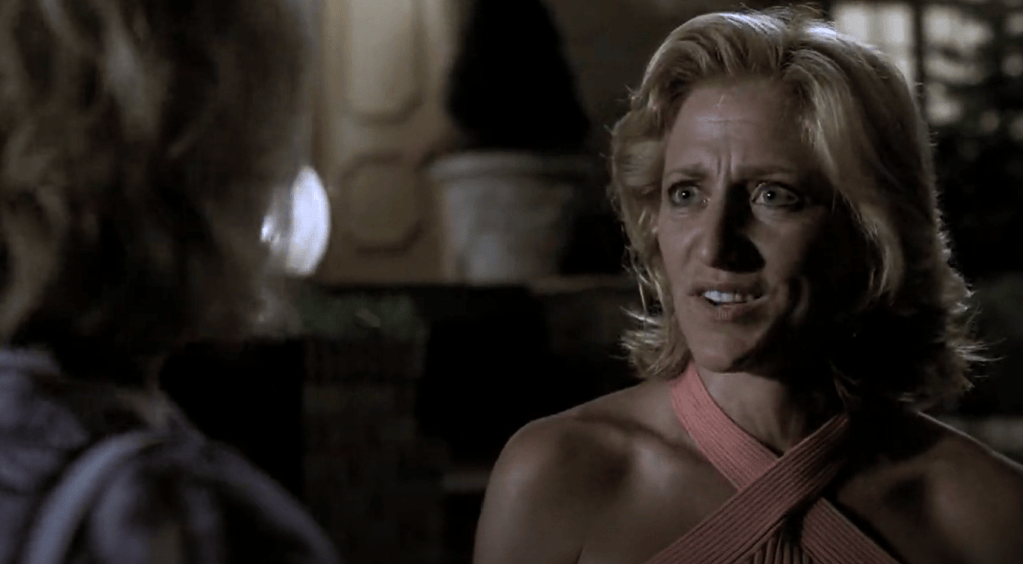
A drunk Carmela overhears an embarrassed Mary apologize to Dr. Fegoli and realizes that she supported her daughter’s decision to exclude Tony from the party solely to protect her image, rather than out of loving concern for her daughter’s marital complications. So, she gives it to her mother:
Carmela: “I remember you telling Aunt Rose you were glad DeAngelis didn’t end in a vowel!”
Mary: “I never said that!”
Carmela: “And when Meadow came out, ‘oh my God, she’s so dark.’”
Mary: “You’re drunk. I’m going home.”
Carmela: “You know, there are Italians all around with their closet self-loathing. I just never wanted to believe my mother was one of ’em. And now what the fսck are you crying about?”
Carmela’s recounting of Mary’s reaction to newborn Meadow’s skin color, along with Mary’s gratitude over DeAngelis ending in an “S,” is SO specific and SO “regularness of life.” And of course, Edie Falco delivers it with incredible authenticity. On top of that, accusing her mother of “self-loathing” helps her forget that she…and her husband…absolutely, positively, conspicuously loathe themselves for reaping the benefits of blood money.
Carmela seizes her mother’s shame as an opportunity to pride herself on the Soprano roots she married into. So, she projects this pride like a crazy lady, and uses it as a rationalization to drive herself back into Tony’s arms and resume her self-loathing. It is NO coincidence that, in the following scene, Tony and Carmela have sex for the first time since their separation.
Hindsight is 20/20, but given the characters’ consistency, it was a foregone conclusion Carmela would reunite with Tony. She just needed excuses like this and a $600,000 lot for her spec house.
Additional Notes
- Carmela gets very drunk just three times in the series: at Livia’s remembrance, here, and at Bobby’s lake house during Monopoly. Her drunk acting is stellar each time.
45
Who invented the Mafia?
Written by Frank Renzulli and David Chase
Directed by Tim Van Patten
Tony cries anti-Italian persecution to deflect criminal involvement, setting a key foundation for the remainder of the series
_______________________________
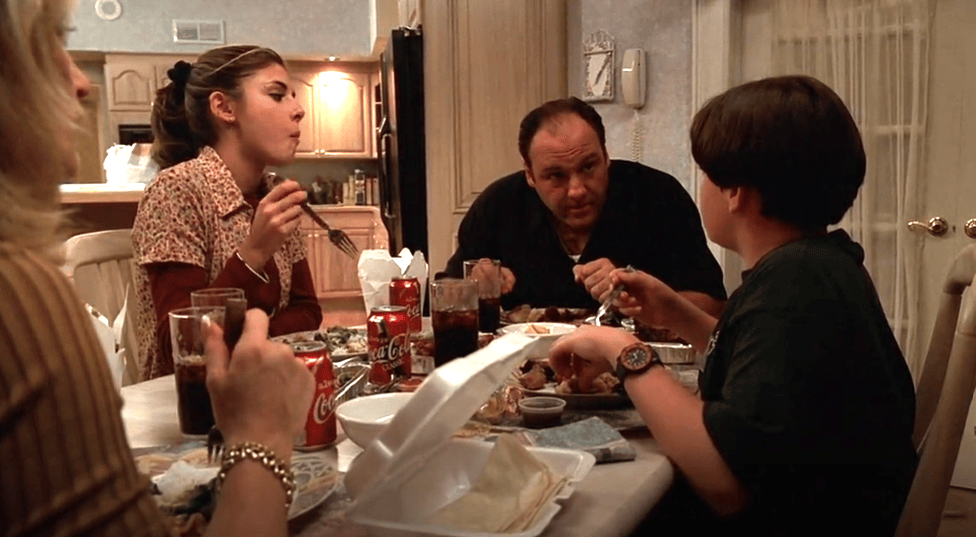
When the FBI arrives with a search warrant, Tony cries persecution, a victimization, denial-empowering tactic Carmela and Meadow rely on throughout the series. In front of his impressionable son and adoring daughter, Tony seizes an opportunity and alleges Agent Grasso’s colleagues “probably frisk him every night before he goes home” solely because he’s Italian. Tony and Carmela proceed to list a number of Italian historical figures (Antonio Meucci, John Cabot, and Amadeo Giannini) and how their inventions and achievements were robbed of proper recognition. And then, Meadow interrupts and provides one of her finest moments:
Meadow: “Who invented the Mafia?”
Tony: “What?”
Meadow: “La Cosa Nostra, who invented that?”
AJ: “Who cares?”
Meadow: “Wasn’t it Salvatore Lucana, better known as Charlie ‘Lucky’ Luciano who organized the five families? Lucchese, Gambino, Bonnano, Profaci.”
Tony: “Is there somethin’ you wanna say to me?”
Meadow: “I just like history, like you, dad.”
AJ: “Can you just shut the fuck up about it?”
Carmela: “Hey!”
Tony: “Hey!”
Jamie Lynn-Sigler beautifully and hysterically captures the scene as she wears a shit-eating grin, and speaks in the most deliberately know-it-all tone possible, asserting herself as the alpha of the dinner table. Meadow challenging the Mafia proves to be one of Tony and Carmela’s worst nightmares. Fortunately for them, they successfully bully their daughter away from crossing that line as the series progresses. Meanwhile, AJ’s complete disinterest in the topic mirrors AJ and Meadow’s growing understanding and awareness as the series progresses; Meadow is both aware and very smart, while AJ might just be too dumb to even ask himself the bigger questions (perhaps until, I’d say, the last two seasons, when he seeks vengeance on Uncle Junior, and befriends amateur gangsters). The scene suggests that Meadow, as she ages, may very well clash with Tony and his organized crime. Instead, as her adolescence comes to an end, she outgrows her smart ass, combative nature and realizes that if she wants to love her dad, she can’t challenge his way of life. As Tony fends off Meadow’s meddling, the conversation transitions to all time Sopranos comedy:
AJ: “Is it true that the Chinese invented Spaghetti?”
Tony: “Now think about it. Why would people who eat with sticks invent something that you need a fork to eat?”
And:
Tony: “And they won’t tell you about Sacco and Vanzetti either.”
AJ: “The two Antichrists that got the electric chair in Massachusetts?”
Meadow: “Anarchists.”
AJ: “Isn’t it Antichrists?”
Carmela: “They were two innocent men who got the chair because they were Italian.”
Meadow: “How can there be two Antichrists? There was only one Christ.”
AJ: “So?”
Additional Notes
- Chase showcases his attention to detail: In light of the FBI’s surprise visit, the Sopranos eat take-out food for dinner, a rare occasion (off the top of my head, the only other time Carmela opts for take-out over cooking is when she’s sick in “Whitecaps”).
- When AJ claims Alexander Graham Bell invented the telephone, Tony replies with agitation: “You see what I’m talkin’- Antonio Meucci invented the telephone, and he got robbed! Everybody knows that!” Tony cutting himself off like that is a textbook display of authentic writing and acting.
- Meadow condescends AJ in perfect, and hilarious, older sister fashion:
- “Like he knows who that is,” she spits to Carmela, who educates AJ under the assumption he’s familiar with John Cabot.
- The emphatic correction from “antichrists” to “anarchists.”
- The follow up of “How can there be two antichrists? There was only one Christ.”
- When Tony credits Italians for giving the world Frank Sinatra, he and Carmela silently flirt, implying that Sinatra’s music is perhaps a romantic component of their marriage. It’s a nice moment, but quite twisted in light of your daughter playfully taunting you for being in the Mafia.

