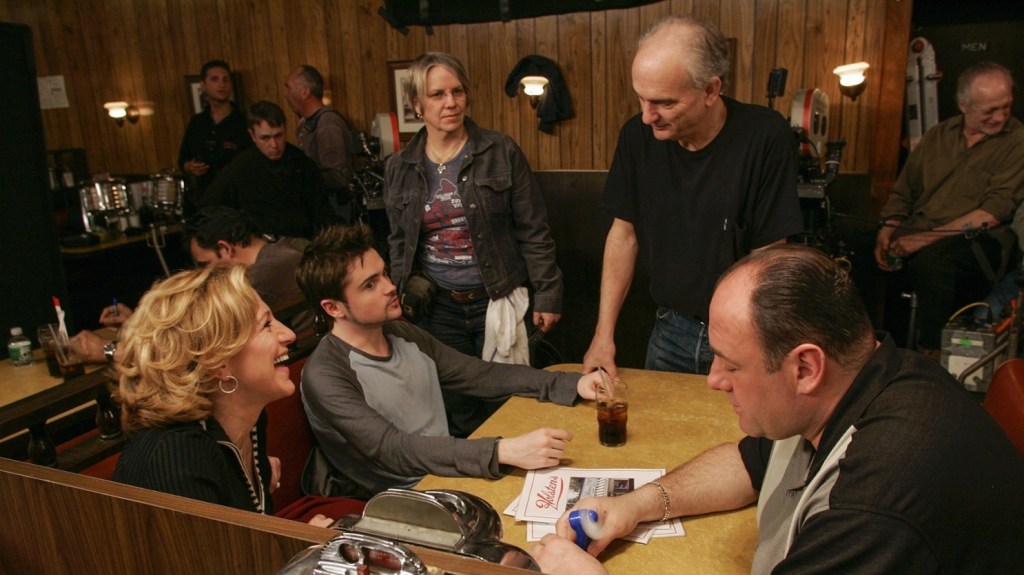
Like any power ranking, I understand there will be scenes that people can’t believe are ranked so high or low, or don’t even make the cut. Just know, I can’t be accused of neglience! I’ve thought and written deeply about these 100 scenes (and countless more). Feel free to leave comments with disagreements of my rankings and/or interpretations! (Spoiler alert, Pine Barrens is not featured in the Top 100).
When assessing the quality of a Sopranos scene, I primarily consider the following:
- How integral and profound is the scene within the wider purpose and themes of The Sopranos?
- Does the scene depict the haunting wonders of the human condition?
- Do the scenes showcase the top strengths of The Sopranos?
If the above is true, my mind spirals (in the most productive way possible), as I think critically by contextualizing the scene in question to the rest of the show.
For example, the brilliance of my #70 scene may depend on the brilliance of #56. Throughout this Top 100, you will routinely see me reference additional scenes in write ups.
The Sopranos follows a tortured man in constant anxiety and fear of getting killed or arrested as he conducts every day business, and the characters around him who suffer similar anxiety from either the same evil, or complicity. Below are the themes that convey the purpose of The Sopranos.
Themes and Purpose:
- Repression and Denial: Nearly every character in this show finds themselves crippled by denial, as they disregard their moral compromise via don’t-ask-don’t-tell policies and fantasy-based logic. And, the more they repress reality, the more they stress themselves out. How they navigate this denial serves as an absolute spectacle and treat to watch. Carmela is the MVP of of this arena, but there are countless worthy runner ups. The show finds itself at its peak during the rare instances in which a character conquers their denial, and confronts reality. It is an exceptional psychological display that every viewer can relate to, albeit on less extreme scales such as murder cover up.
- Rationalization: These morally compromised individuals’ entire self worth hang in the balance of rationalization. In other words, they concoct logic that makes them feel better about themselves despite such flagrant moral corruption.
- Self-loathing: With the denial, complicity, and evil comes these characters’ disgust of themselves, particularly the ones with semblances of a moral compass (Tony/Carmela as opposed to Ralph). As a result, they keep themselves afloat by way of preposterous, circuitous avenues of denial. I’d say “self-loathing” is more aggressive/accurate terminology than “guilt” for these folks.
- Aversion to the regularness of life: In season 1 episode 8, “The Legend of Tennessee Moltisanti,” Christopher bemoans to his uncle: “I don’t know Tony. It’s like just the fuckin’ regularness of life is too fuckin’ hard for me or something, I don’t- I don’t know.” In Season 5, Tony Blundetto gives up on his good, honest goal of opening a massage therapist practice, because he craves the “fun” life of organized crime. While they get to reap the benefits of the easy way out, the cons include the chance of getting arrested or whacked at any moment, and internal moral strife (depending on their degree of shame). When watching Sopranos episodes with my mom, she’ll repeat, like a parrot, “Don’t you enjoy your boring life?” Yes.
- Identity crisis: Of course, these characters thoroughly enjoy the benefits the Mafia lifestyle grants. But, they are also acutely aware of the benefits that honest men and women reap, and fantasize about being in those shoes. In particular, the series pays close attention to the identity crises of Tony, Carmela, Christopher, and Meadow.
- Everything comes to an end: Tony knows this, and spends all series trying to dodge it, or at least, delay it. One way or another, the series’ final shot fulfills this prophecy that David Chase lays out in the series’ first episode.
The Strengths of The Sopranos:
- Authentic dialogue: This, to me, is the most apparent strength of The Sopranos that separates itself from every other show by a country mile. In every other show, dialogue may be good, but it always feels fictional. The dialogue is too pointed, and too on the nose. With The Sopranos, I forget that I’m watching fiction; the dialogue content and conversation flow carries like that of real life human beings. The dialogue often has nothing to do with plot development, and everything to do with developing authentic characters through the regularness of life. A favorite example of rich, detailed, authentic dialogue that comes to mind is Carmela raging about Svetlana, once she learns of her affair with Tony: “The nurse who took care of your mother, who I liked? Who I talked to on the telephone about your mother’s alopecia and her bowel movements? Who you told me came from an agency? Who I shared vodka with the night your mother died? You’ve been fucking her?!” The bolded words stand out to me as perfectly beautiful, impressive, and authentic dialogue that no other show has ever come close to producing.
- Interconnectivity, plot development, and character development: Every episode connects to other episodes through callbacks and foreshadows. More importantly, each episode demonstrates the exceptional and meticulous plot and character development that makes The Sopranos such a remarkable feat. Examples:
- In Season 2 episode 5, “Big Girls Don’t Cry,” Adriana says to Christopher (“revealing your inner most feelings is the best kind of writing”). This foreshadows Christopher’s movie, Cleaver, which depicts Christopher’s fantasy of Tony’s downfall and proves highly consequential 4 seasons after Adriana’s aforementioned line.
- In Season 4 episode 2, “No Show,” Tony implicitly gives Meadow an ultimatum, and it permanently alters Meadow’s character development, and shifts how she navigates her denial and rationalization thereafter.
- In the pilot, Tony expresses his admiration (and envy) of Gary Cooper, the strong, silent type. Someone who was tough, and did his work without complaining or crying to a shrink…which is also reflective of someone who can take heat without ratting out his friends. This sets the foundation for 1) everything with respect to rats cooperating with the FBI 2) why Tony resents both himself and his son for being weak and vulnerable.
- In Season 6 episode 11, “Cold Stones,” Carmela observes how AJ’s got this “dead streak” in him and how he carries himself with a “big ‘fuck you’ to everything.'” When listening to Carmela talk about this, it’s obvious AJ’s “dead streak” stems from Livia (and Tony). Automatically, my mind rewinds 4 seasons to AJ’s hospital visit with Livia in Season 2: “If you want my advice, Anthony, don’t expect happiness. You won’t get it, people let you down. And I’m not naming any names, but in the end, you die in your own arms…it’s all a big nothing.” Imagine if your Grandman said that to you at age 14? It’s no wonder AJ ends up the way he does.
- Everything that happens makes sense: Outside a number of unrealistic broad daylight murders, the viewer is never left asking themself “Why did that happen?” or “I’m not sure I buy that?” or “Why wouldn’t so and so character do xyz instead?” Why is this the case? Because the show is not lazy. It is carefully and meticulously constructed via plot and character development, targeted for an audience paying full attention rather than multi tasking with twitter scrolling. The show respects its audience, and doesn’t take shortcuts by relying on cheap, unrealistic thrills that compensate for careless writing. In every single episode, I’ll see multiple scenes where I think to myself just how much xyz makes sense given how it’s been developed in the episodes/seasons leading up to this point, as well as what occurs thereafter. AJ’s spiral in Season 6B is my favorite example; you can trace it back to every single episode leading up to it.
- Humor: Thanks to the characters and their unrivaled authenticity, this show is as funny as the average pure comedy you can think of. Even when they’re entirely earnest, characters like Junior, Phil Leotardo, and Christopher are roll-on-the-floor hysterical. I will share what is personally the funniest line of the series: when Paulie references the Cuban missile crisis, Christopher replies “That was real? I saw that movie I thought it was bullshit.” (I laughed out loud as I typed this).
- A “show, don’t tell” approach that builds deeply layered characters. Throughout the show, viewers know what’s eating at Tony and Carmela, for example. But Tony and Carmela don’t tell us, and neither do the writers. But, the plot and characters are so well constructed that we usually know what’s going on in the characters’ heads…even if the characters themselves dont’ know.
e-mail:
nickdianasopranostop100scenes@gmail.com
 The Sopranos: Top 100 Scenes