100
What are you so afraid’s going to happen?
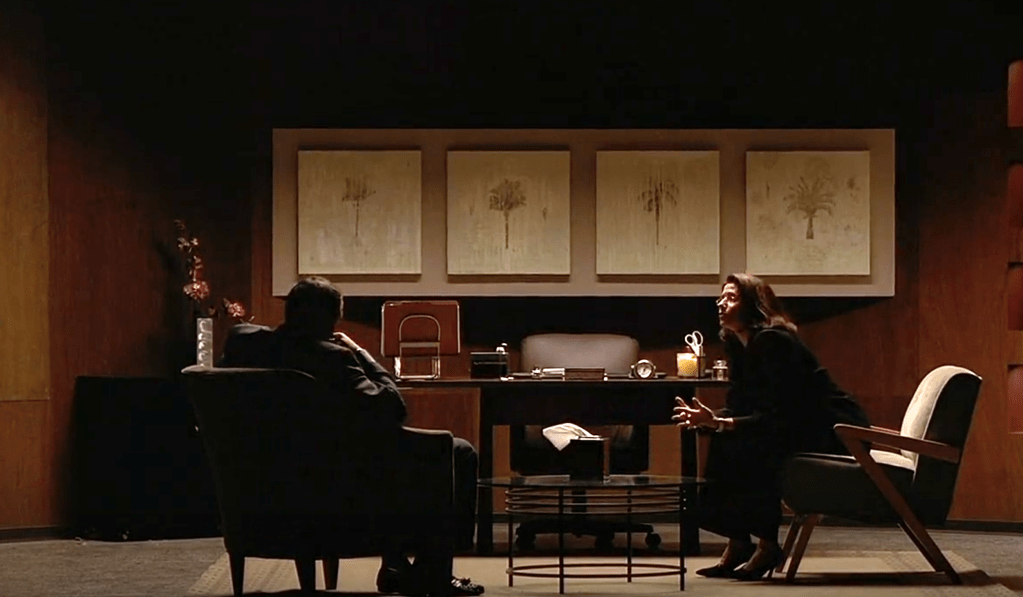
Written and Directed by David Chase
Melfi helps Tony confront his greatest fear.
_______________________________
In just his second therapy session, Tony details a dream in which he loses his penis. Considering his social, familial, and professional surroundings, (not to mention his jealous admiration for “the strong, silent type” like Gary Cooper), therapy threatens Tony’s manhood. Hence, the detached penis. And then, a bird scoops it up and flies off with it. Melfi helps Tony understand his emotional attachment to the ducks in his pool:
Melfi: “When the ducks gave birth to those babies, they became a family.”
Tony: “You’re right. It’s a link. A connection. I’m afraid I’m gonna lose my family…like I lost the ducks. That’s what I’m full of dread about. It’s always with me.”
Melfi: “What are you so afraid’s going to happen?”
Tony: “I don’t know.“
This dialogue beautifully establishes the show’s foundation. To answer Melfi’s question, The Sopranos, at its core, follows a protagonist constantly peering over his shoulder for hitmen or the FBI. Whether he’s killed or imprisoned, two very plausible routes in this line of business, Tony will lose his family. The infamous diner scene in the series finale, capped off by the cut to black, fulfills David Chase’s prophecy established right here in the pilot. That’s what Tony’s full of dread about. It’s always with him.
99
Star Ledger says Delbarton’s gonna be even tougher this comin’ year

Written by Michael Caleo
Directed by John Patterson
Junior makes his infamous varsity athlete roast.
_______________________________
Throughout Season 5, many characters (Feech, Tony B, Finn, and now, Uncle Jun) undermine Tony’s authority and power. Thanks to this threatened authority, we get a classic scene with one of the show’s most iconic lines. A restlessly hungry Uncle Junior, starting to really lose his marbles, impatiently scolds Janice with “are we gonna eat today or what?” After AJ and Bobby give me the honor of discussing my alma mater, Junior says to AJ “Your father never had the makings of a varsity athlete.” Earlier in “Where’s Johnny,” Junior attacked Tony’s athletic shortcomings during a sit down with a New York faction, so the insult remains fresh in his deteriorating brain. Here, Tony warns him not to undermine him again, and the Sopranos continue to mang’. When Uncle Tom arrives and mentions a Jets draft pick, Junior again blurts the varsity athlete line. Junior responds to Tony’s inevitable temper tantrum with a priceless “You don’t like the way I talk? Get out of my house!” Once Tony abides, Junior hilariously refers to him as “a god damn hothouse flower.” News flash, everyone in Uncle Junior’s line of work is a “god damn hothouse flower.” Also, Tony’s considerable insecurities surrounding his varsity athlete makings might stem from AJ’s gridiron success. It’s no secret Tony resents AJ’s frail masculinity, so when AJ’s varsity status remains unquestioned, Junior inadvertently brings Tony down to AJ’s level, perhaps serving as Tony’s true source of frustration. To demonstrate just how much real estate Uncle Jun occupies in Tony’s head, Tony addresses Uncle Junior’s varsity athlete standards way back in the pilot.
98
Tomorrow I’ll be on time, but you’ll be stupid forever
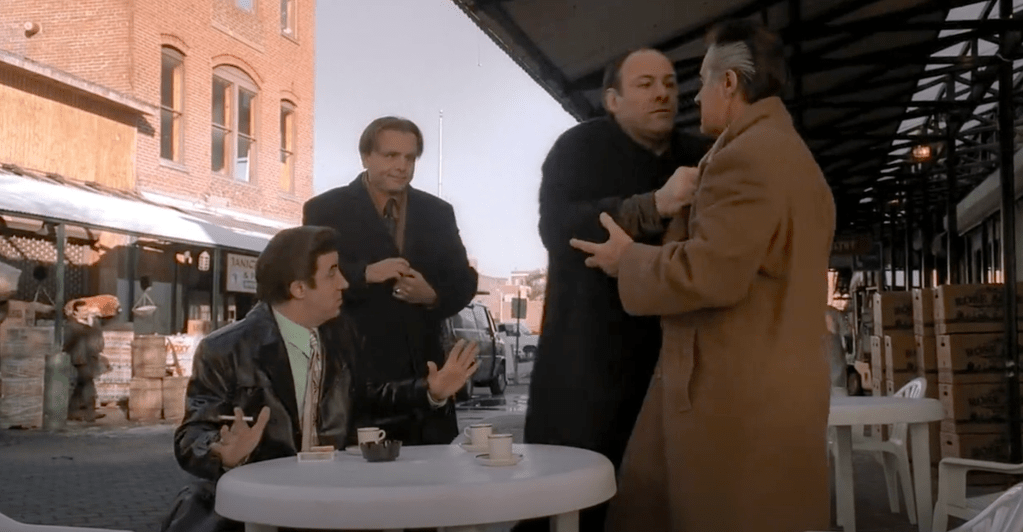
Written by David Chase and Lawrence Konner
Directed by John Patterson
Tony’s subconscious screws Paulie’s wallet.
_______________________________
Putting it lightly, Tony’s got a lot going on. He’s dealing with Christopher’s defiance following their biggest showdown yet, he strangled his goomar after she threatened to call Carmela, AJ’s been expelled, and to top it off, he had to order the death of Rosalie and Jackie’s son (which, consequently, has Meadow teetering on the edge of completely turning against him and Carmela). Suffice to say, Tony doesn’t really give a shit about Paulie’s split on some cat burglar heist. But, what better than a Ralph vs. Paulie season finale sit-down? Obviously, Ralph’s been up to no good. He killed Tracee, he rejected his boss’ drink offer, and his girlfriend’s son robbed a card game and shot at made guys. But, Ralph and his construction money hold all the power. Paulie can’t fathom that Tony rewards him just $12,000/$50,000 from that “Morristown bullshit.” But of course, he has no idea that he buried his chance at a bigger share before Ralph’s tardy arrival.
Any time Paulie opens his mouth, he risks aggravating Tony. This time, though, he triggers Tony’s supreme insecurity: his relationship with his mother (and Green Grove to boot!). Paulie rambles on and on about moving his mother into the luxurious Green Grove, how it’s money well spent, and how his love and generosity moved his mother to tears. He even brags “I’m the hero now, boy,” his nail in the coffin for a chance at a fair split with Ralph. And now, Paulie’s lightened wallet interferes with his flexibility to give his mother what Tony wishes he could’ve given Livia; an appreciated retirement home. Tony’s decision to appease his top earner, and (likely subconsciously) screw the underling who flaunts his perfect mother-son relationship, proves to be very pivotal. Just a few scenes later, Paulie whines to Johnny Sack, and John seizes a golden opportunity to play Paulie like a fiddle by extracting inside information from Paulie the vulnerable blabbermouth. This costs Tony lots of scharole down the line, and nearly gets Carmine Sr. killed in the process. This sit-down is the first domino in the NJ-NY struggle that stretches all the way through the series finale.
Additional Notes:
- Ralph’s banter and Paulie’s reaction are classic.
- “Little Paulie was good to go, fuckin’ car never came. They left him waitin’ outside his house like an asshole, fuckin’ 11 degree weather” is one of Paulie’s funniest lines.
- Another hilarious exchange: Tony: “Ralphie, give him 12k.” Paulie: “I can’t believe this!” Ralph:“Why not? Last year you believed that flying saucer was over East Rutherford.”
97
Sopranos been waitin’ a long time to take the reins
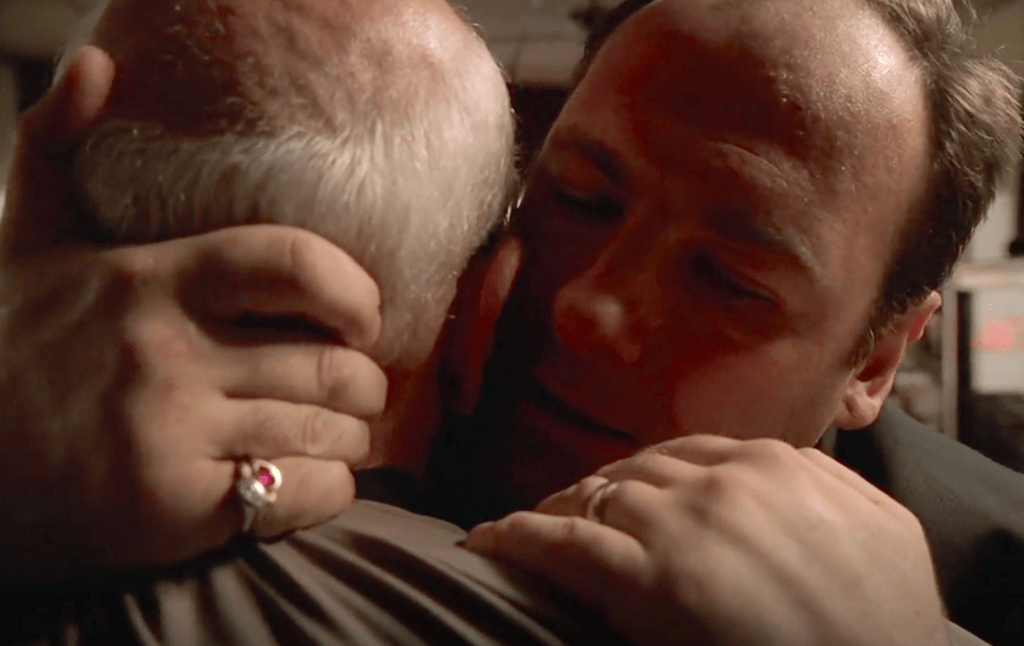
Written by Jason Cahill
Directed by John Patterson
Tony surrenders the big seat to Junior.
_______________________________
As for the more iconic moments, I think this truce gets swept under the rug. Through all Tony’s faults, he’s not the most egotistical mafioso (think Phil Leotardo, Johnny Sack, or even Junior). Usurping Junior has little to do with pride, and everything to do with the good of the family (and of course, Tony’s wallet). Tony shares the same understanding as everyone else – that he’d be a solid boss, while Junior will just give everyone agita. Considering everyone’s best interest, one could even classify this scheme as selfless and honorable! This, of course, is all thanks to Melfi, who gives Tony sound advice: smoothen the tension with Livia by giving her the illusion of control. Melfi, inadvertently, gives Tony his all time greatest business idea: trick Junior into thinking he’s running things. Immediately after learning of Jackie Aprile’s passing, Tony drives to Junior’s diner, and parks in the middle of the street, emphasizing that it’s 1999 and the Mafia’s in charge. As Tony sits, he professes “Sopranos have been waiting a long time to take the reigns”- a powerful reminder that Tony, Junior, and Johnny Boy have been the core of this crime family for decades. Once Tony delivers the good news, Chase includes one of his best Godfather odes as Tony embraces his uncle and whispers his “asking price” in his ear, an epic parallel to Michael and Fredo Corleone. And, well here’s the difference between Michael Corleone and Junior Soprano: Michael swiftly kills his traitor, while Junior completely fumbles the mission. The scene is exceptionally special when considering that from this point onward, it’s all downhill for Junior.
Additional Notes:
- It’s quite wise of Tony to name his asking price after surrendering to Junior.
- This development is crucial in the Melfi-Tony relationship, as it’s the first of many instances where Melfi unknowingly aids Tony in his criminal operations.
96
The wouldn’t know how to treat that shit
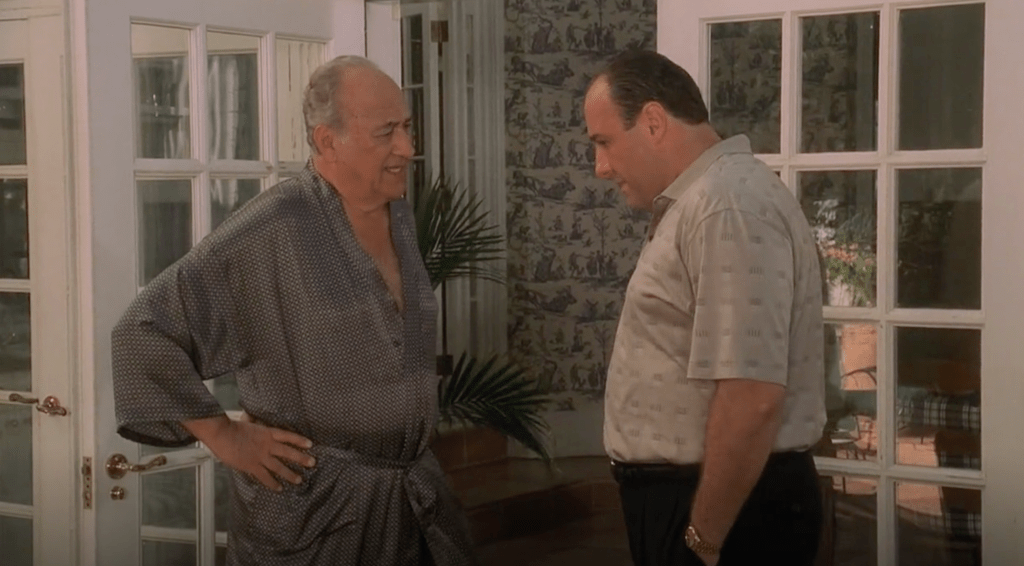
Written by Terence Winter
Directed by Tim Van Patten
Tony informs Hesh he sees a shrink, and learns his father used to pass out.
_______________________________
Constantly, Tony demonstrates his resentment toward his own anti-Gary Cooper nature. Tony, full of shame and nerves, can hardly look at Hesh as he prepares to confess he’s been seeing a shrink. But first, he begs Hesh to help him understand why he’s so unlike Gary Cooper:
Tony: “Alright, on any fuckin’ scale you want to use, things are going good. I’m firmly in charge, no trouble there. My family’s healthy. So, why the fuck am i ripping phones out of the wall in front of my kid and screaming at my sister all the fuckin’ time, although, she is totally unimportant to me?”
Hesh: “You got a lot on your mind.”
Tony: “Cause I’m the boss. You see, that’s the point. You never saw Carlo or Lucky or Douglas MacArthur going around punching fucking walls.“
Of course, Hesh chalks Tony’s problems up to a full plate, rather than affirming how stress inevitably follows the constant fear of death and incarceration. Tony proceeds to tell Hesh about his shrink, and that he passes out. Tony, shocked by Hesh’s revelation that his father suffered from the same issue, asks if his dad consulted a doctor. Hesh laughs the idea off with “Your father, what are you kidding? It wouldn’t have made a difference in those days. They wouldn’t know how to treat that shit.” Hesh helps us, and perhaps Tony, understand that maybe Tony isn’t that crazy. Maybe, just maybe, he’s a product of his generation – someone who “came in at the end. The best is over.” And, what’s the best? Well, in this case, a time when people suppressed their distress from growing into distractions.
Hesh mentions a neurological study that examines how the human brain responds to fear, and details an example of someone hearing a tape of a parent criticizing them. Unfortunately for Tony, he has a far more extreme and traumatic experience listening to his mother on tape. Triggered by Hesh’s anecdote, the camera cuts to Tony as anxiety floods his face – he nods ever so slightly, blinks, winces, and sits up. It appears as though Tony dodges a panic attack right then and there. Then, Hesh starts talking about himself, and Tony refuses to listen. Without fail, when forced to listen to other people’s problems, Tony checks out (Carmela, Meadow, Gloria, Hesh, Eugene, Christopher, Janice). Speaking of Janice, it is fucking hilarious that Tony states “she is totally unimportant to me.” Gandolfini masterfully executes this scene.
Additional Notes:
- Hesh and Tony talk over each other (to demonstrate that Hesh has already disregarded Tony’s problem, and that Tony remains selfish), and the editing is horrendous. It has absolutely no flow.
95
I’m the boss for Christ’s sake!

Written by Frank Renzulli
Directed by Henry J. Brochtein
Livia orders Junior to whack her son.
_______________________________
“You gotta watch this show about a gangster whose mom tries to kill him for putting her in a luxury retirement community.” Imagine a friend saying that to you in 1999? Man, what a time to be alive. Livia kicks and pouts her way to Green Grove after an onslaught of tirades against “that nursing home” filled with “babbling idiots.” But, as the season progresses, she settles in and the “retirement community” seems to give her a sense of calm and joy. That is until AJ visits her during his suspension (for getting drunk on the blood of Christ), and lets slip that Tony sees a psychiatrist. Next thing you know, Livia tells Uncle Junior, Uncle Junior tells his consigliere Mikey Palmice, and Tony unknowingly lands on thin, thin ice. If it’s not bad enough that Tony “goes to talk about his motha” to a shrink, he cracks another layer of ice once he sells Livia’s house. Promptly, Livia summons Junior to Green Grove to exact revenge on Tony for putting her in a lovely retirement community, going to therapy, and selling her empty house. It is the decisive moment of Season 1, and stands as one of the most iconic moments ever put to screen. If there’s any good Tony does in his life, it’s attempting to take care of his impossibly wretched, thankless, and miserable mother. Nevertheless, Livia wields her power once again by manipulating Junior into whacking Tony, in so many words. As intended, Livia masks Tony’s death sentence with grievances over sons mistreating their mothers by placing them in Green Grove:
Junior: “Three of my capos have their mothers in this place?!”
Livia: “Instead of living in normal homes with their sons, like human beings.”
Junior: “This must be some kind of fuckin’ end move! What, do they think I’m stupid?! We’ll see.”
Livia leaves just enough plausible deniability to (unsuccessfully) feign senility in the Season 1 finale, but Junior’s “If I don’t act! Blood or no- I have to” serves as the nail in the coffin as the FBI’s tapes agonize Tony. Family or not, Tony can forgive his uncle for trying to kill him – it’s standard business procedure given the scheme Tony spearheaded. This explains his fairly amicable relationship with Junior throughout the rest of the series. His mother trying to kill him for any reason at all, let alone this? Well, there’s not much room for forgiveness in that department.
Additional Notes:
- Junior’s “pleurisy” is one of the series’ best malapropisms, and certainly under the radar…at least with respect to present day Sopranos meme culture.
- Corrado Soprano’s theatrics thrive when he grows irate. This time, his outrage and defeat compound bewilderment as Junior quickly comprehends Tony and the capos’ “fuckin end move,” as Livia reveals that Larry Boy, Jimmy Altieri, and even “that sneak from Manhattan,” Johnny Sack, regularly meet at Green Grove. His crescendo from initial confusion to exasperation is hysterical.
- Half the people I talk to upon finishing Season 1 are very confused by the notion that Livia tried to kill Tony. This speaks to the cleverness of the writers, who, as usual, refuse to give the audience explicit answers. Subtleties are necessary in the Mafia world, as the likes of Tony, Carmela, Livia, and Johnny Sack must be impeccable with their word to avoid self-incrimination, whether legally or morally.
- “In Denial, Anger, Acceptance,” the audience catches a glimpse of Livia’s Mafia power when Junior seeks her permission to whack two members of Tony’s crew, Christopher and Brendan Filone.
94
You’ll never leave your wife
Written by Frank Renzulli
Directed by Timothy Van Patten
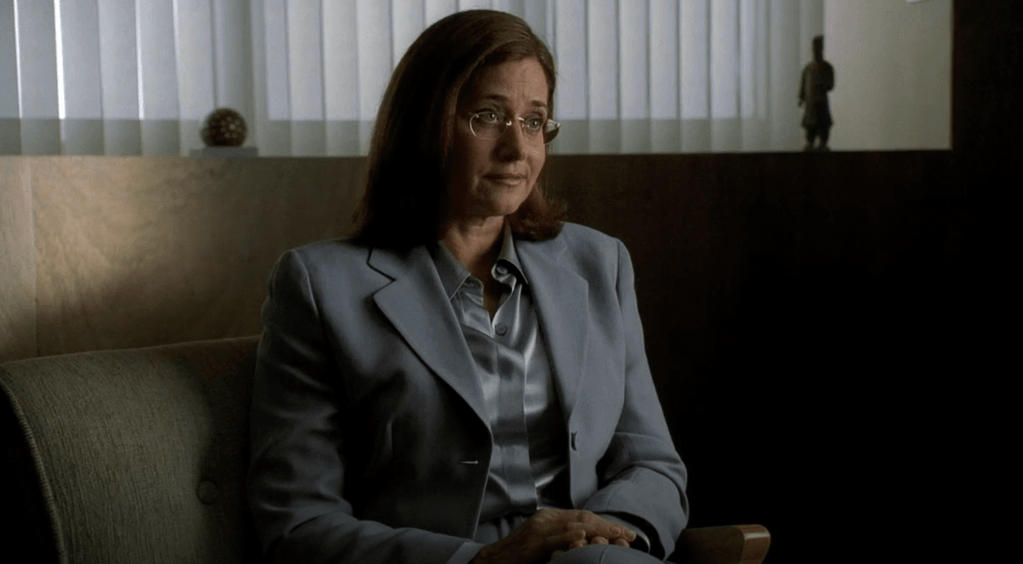
Melfi dissects Tony’s relationships with Gloria, Livia, and Carmela.
_______________________________
Earlier in the therapy session, Tony presumably shared his epiphany connecting Livia and Gloria. While Tony and Melfi agree on Gloria and Livia’s similarities, Melfi draws the distinction between Tony’s relationships with the respective “bottomless black holes”: “Try to please her, try to win her love…We need to repeat what’s familiar even if it’s bad for us. Gloria’s need for drama, the selfishness, the incessant self regard. At one time, in your mother’s hands, it passed for love.” Melfi’s answer of repeating what’s familiar is relatable to everyone, but most of all to Tony, who refuses to accept that his entire lifestyle (killing, cheating, stealing, intimidating), is what traumatizes him into panic attack induced therapy:
Melfi: “But I think we should deal with why are you so attracted to dangerous relationships? Why do you put your marriage in such danger?”
Tony: “Maybe I’m lookin’ for a way out. You ever think of that?”
Melfi: “Anthony, you’ll never leave your wife.”
Tony: “Bullshit. There’s a limit to how much shit–”
Melfi: “She might leave you, but you’ll never leave her. Despite your mothering, you made one good decision in your life vis-a-vis women, you’re not gonna throw that over. Your own selfishness is too strong to let that happen.”
Tony: “Alright, alright.”
Melfi: “Actually, in spite of everything, you’re a very conventional man.”
Tony: “I said alright.”
Melfi asks why he’s so attracted to dangerous relationships, an answer Tony (or at least the audience) explicitly receives when he learns of Gloria’s suicide: he’s a toxic person who’s attracted to toxicity. More specifically, as Melfi points out, his inability to satisfy his mother leaves him with the fantasy to please another unpleasable, bottomless blackhole. Of all the distress that haunts Tony, nothing cuts deeper than his relationship with his mother, poisoned by her unrelenting discontent. It’s only natural that he seeks to nurse that open wound in his romantic relationships.
As Carmela spends the episode pondering divorce, Tony, for the first time, shares the same idea. And, as we discover in “Whitecaps,” Melfi’s right; Carmela, against Tony’s wishes, leaves her husband (or at least, tries to). Melfi delivers quite the realization to Tony: Carmela (at least for Tony’s standards) is a great woman and wife. And, instead of chasing clinically insane women like Irina and Gloria, he ought to treat Carmela right before it’s too late. Melfi’s emphatic focus regarding Tony’s love life is apparent; when else does she cut him off mid-sentence? Melfi cracks The Sopranos code: despite his position as a mob boss, Tony Soprano is a regular, relatable guy who depends on family and marital stability.
93
Look at yourself Tony! Look how angry you are!
Written by Jason Cahill
Directed by Allen Coulter
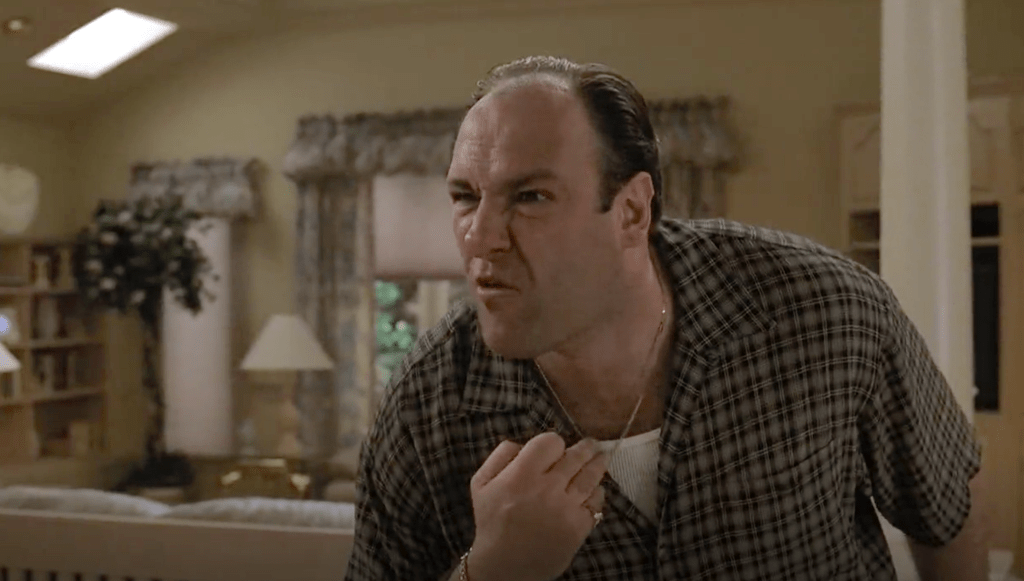
Janice returns from Seattle and tries to interfere with Livia’s house sale, and Tony loses his shit.
_______________________________
The Season 2 premiere introduces the conniving, opportunistic Janice “Parvati” Soprano. After 20 years out west, she storms in like a bull in a china shop:
Janice: “My therapist says I’m regressing.”
Tony: “Oh, your therapist. Who pays for that?”
Janice: “The state of Washington. Total disability.”
Poolside, Tony shuts Janice up with some cash to assist Livia, and the camera pans to the pool cleaner’s undulating form and motion, drawing a parallel between Janice and a snake. Later in the hour, Janice mentions Livia’s house sale to Barbara, and Barbara warns her not to get involved, as she knows Janice just wants a cut while Tony has been the only kid tending to Livia’s affairs. When Tony discovers that Janice removed the for sale sign from Livia’s yard, Tony goes completely ape shit on his sounding board, Carmela:
Tony’s warranted outburst, complemented by Carmela’s attempt at devil’s advocacy, is completely hysterical. Both Carmela and the audience, however, don’t yet know just how warranted Tony’s outburst is, and there lies the significance of the scene. Tony’s diatribe vigorously, hilariously, and effectively establishes the precedent of Janice Soprano’s purpose in the show; a cunning, resilient mooch who gives Tony as much, if not more, agita as any other character in the show. Fast forward four seasons to “Moe n’ Joe,” when Melfi suggests that Janice perhaps performed an act of kindness, Tony spits back “Janice only does acts of Janice, trust me.”
Additional Notes:
- Tony’s intolerance for Janice climaxes in the following scenes:
- During Tony’s fight with Janice in “Where’s Johnny,” where he expresses his resentment toward Janice for running off and leaving him behind to deal with Livia, among other grievances.
- In the aforementioned therapy session in “Moe n’ Joe,” where Tony rants with sincere anguish: “I’ll tell you what I inherited, my mother. Janice got laid. She took off. She laughed at all this shit. Then the trip’s over and she’s back and she’s one of us. And she wants her piece. Well, let me tell you, she gets nothin’! Cause I got the scars! So it’s mine!”
- Tony’s “fuckin’ bitch!” and Carmela’s subsequent “Go have a beeah!” are so, so funny.
- Tony’s outburst in spite of Janice’s absence from the scene says a lot about the real estate Janice occupies in her little brother’s head.
- I’ve had the pleasure of having a nice conversation with Aida Turturro, the actress who plays Janice. She is a sweet woman, and the polar opposite of her character.
- Additionally, Carmela speaks to the episode’s title, “Guy Walks Into A Psychiatrist’s Office,” and blames Tony’s anger on the absence of therapy. With Janice having just mentioned that she too sees a therapist, Tony may feel Carmela brings him down to Janice’s level. But, two scenes later, Tony tracks down Melfi, and requests her service.
92
All I did for this kid and he fuckin’ hates me so much!
Written by Terence Winter
Directed by Alan Taylor
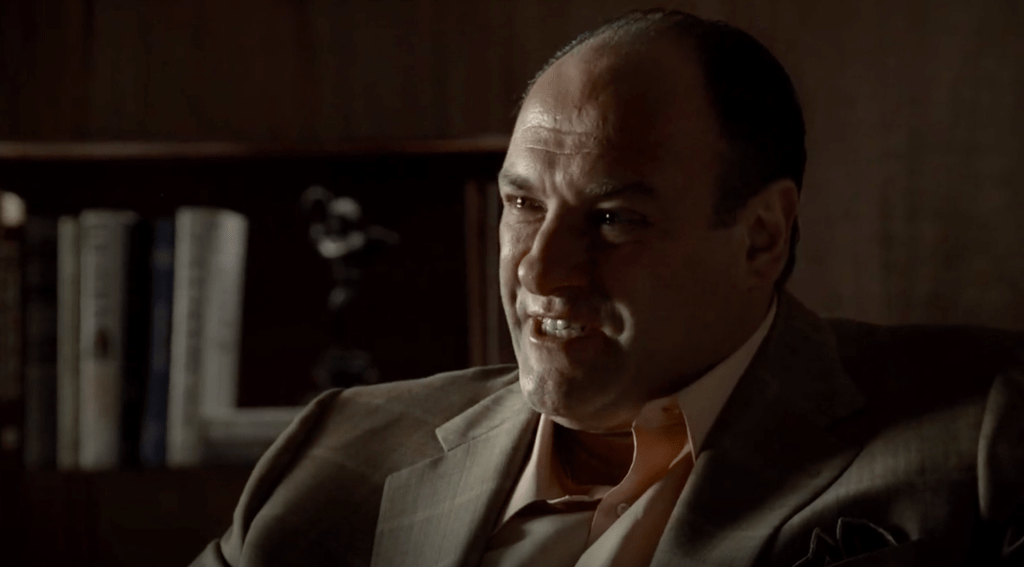
Tony unravels after coming to terms with Christopher’s hatred for him
_______________________________
In Season 2’s “Big Girls Don’t Cry,” Adriana encourages Christopher’s movie-making aspirations: “You wanna write? Feelings is what it’s all about. Revealing your innermost feelings is the best kind of writing.” When you connect Adriana’s advice to both Tony’s therapy session in “Stage 5” and Christopher’s fate, I can confidently say Terence Winter, who wrote both “Big Girls Don’t Cry” and “Stage 5,” employs the most brilliant foreshadow I’ve ever seen. Amid Tony’s (and Carmela and Rosalie’s) realization of Christopher’s repressed hatred for him in light of his (subconscious) portrayal of Tony in Cleaver, Tony appears visibly distraught and emotionally wounded. The Cleaver depiction of Tony as some “asshole bully” signs Christopher’s death certificate, with this therapy session preceding the episode’s outro; a dooming embrace between Christopher and Tony at Caitlin Moltisanti’s baptism (I have this scene ranked very, very high). Cleaver humbles the hell out of Tony, much like Melfi when she rejects Tony’s date request. Both instances are especially humbling and hurtful, as the two people who know his deepest and darkest secrets attack his character.
Naturally, Tony doesn’t own up to his involvement with Adriana or his undermining of Christopher’s sobriety efforts (among a laundry list of other road bumps in their relationship). But, deep down, it’s apparent Tony’s aware of his role in the deterioration of his relationship with Christopher, which contextualizes Tony’s decision after Christopher swerves off road: “I think he fuckin’ despises me. It’s pretty obvious. Wants to see me dead.” As Tony weeps over his protege, the end of their bond feels palpable. The scene concludes with a perfect bow – Melfi, understandably, asks Tony if perhaps his interpretation is an over-analysis: “I’ve been coming here for years. I know too much about the subconscious now.”
Additional Notes:
- While Tony’s been using Christopher to become his successor, I think here, Tony expresses genuine sorrow over losing Christopher the friend, rather than Christopher the bullet proof vest.
- Arguably the biggest theme of Season 7 is Tony’s relationship with a multitude of friends and confidants coming to an end: Christopher, Hesh, Melfi, Junior, and ALMOST Paulie and Bobby. Christopher hurts the most.
- Tony’s so frantic and desperate for answers that he actually brings the Cleaver DVD to Melfi’s office in the hopes that she’ll analyze it for him.
91
First off, it wasn’t an offer. It’s my position.
Written by Terence Winter
Directed by Tim Van Patten
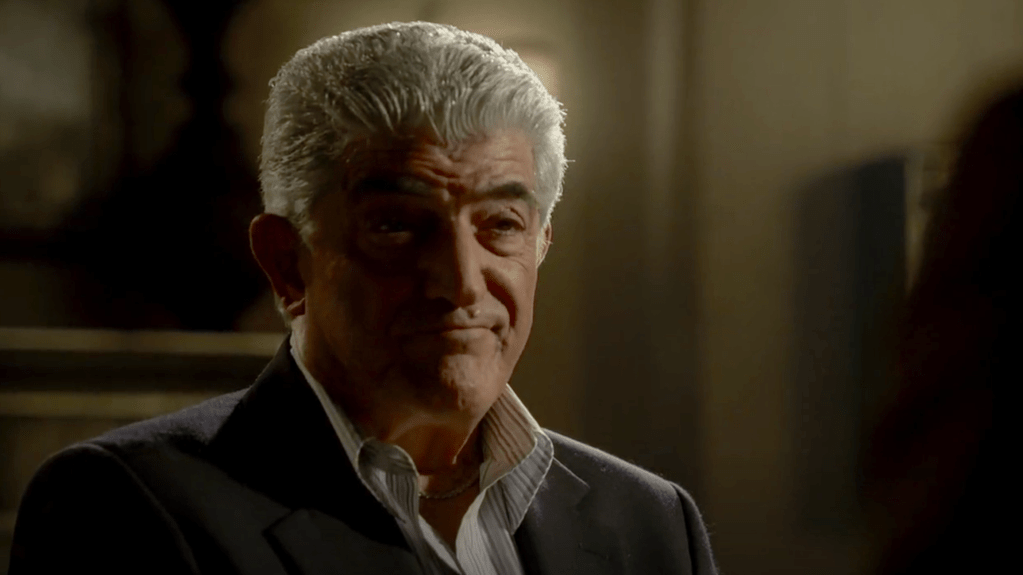
Phil has compromised enough.
_______________________________
Before diving into one of the most iconic moments in the series, let’s recap why Phil’s had enough:
- He couldn’t exact proper vengeance when that “animal Blundetto” killed his brother.
- Tony was passive about the Vito issue, while Phil was aggressive, to say the least.
- Tony sees Phil in the hospital after his heart attack, and emasculates him by taking his “fat fuckin’ hand in friendship” and bringing him to tears by reminding him to take it easy in this life, because eternal life won’t be as forgiving.
- One of his capos, Fat Dom, was last seen in New Jersey.
- As he lamented to Butch at the end of “Stage 5,” Phil’s family has been taking shit from the “medigans” ever since “Leonardo” was changed to “Leotardo” at Ellis Island.
- Worst of all, he did 20 fuckin’ years.
Disagreements on the vitamins and asbestos push Phil’s long brewing animosity over the edge, so Tony schedules a Brooklyn sit down in a desperate attempt to resolve the escalating tensions (with Christopher in the ground, the sit down inner circle now includes Bobby). Phil, with his late kid brother in mind, condescendingly taunts Tony over Christopher’s death: “The grieving process, it takes time the closer you are to somebody.” Phil persists with his patronizing assertion of dominance, and plays hardball when Tony tries to negotiate Phil’s 25% offer on the asbestos deal down to 15%: “First off, it wasn’t an offer. It’s my position. 25%.” Tony’s fucked, and he knows it. In an effort to get Phil to budge, Tony calls back to when they “shared an understanding about life” in the hospital- the inevitability that everyone in this business is bound for damnation, and the more peaceful their business, the longer they can delay, or even prevent, their sentence to hell. Phil laughs off Tony’s attempt at sentimentality, and Tony essentially begs for a “compromise.” Phil replies with one of the most iconic lines in the series: “You want compromise? How’s this; 20 years in the can. I wanted manicott. I compromised. I ate grilled cheese off the radiator instead. I wanted to fuck a woman, but I compromised. I jacked off in a tissue. You see where I’m goin’?” Phil conducts himself with extreme entitlement given his time behind bars; so much so that Phil’s 20 years in the can is one of the most meme’d Sopranos references among online Sopranos fandom (of which I have consumed quite a bit of).
Outside of this infamous “compromise” speech, here are three pertinent instances in which the Shah of Iran grouches over his time in the can, while simultaneously sporting a badge of honor:
- In “Moe n’ Joe,” Phil and the New York guys watch Johnny Sack allocute in federal court on live television. Phil, in disgust, says “Fuckin’ nauseating…I did 20 fuckin’ years!”
- At his late brother’s birthday party in “Stage 5,” Phil leverages his lost time in the can as motivation to assert his dominance going forward: “20 years inside, not a fuckin’ peep. And for what, to protect the likes of Rusty fuckin’ Millio? Doc Santoro?”
- In the following episode, “Blue Comet,” Phil cites prison time as a justification to whack Tony: “Anthony Soprano has no respect for this thing. He’s never been in the can, not really.”
Everything in The Sopranos is meticulously developed, including Phil’s bitterness about his 20 years, which ultimately contributes to his decision to “whack a boss.” Before arriving at this decision, Phil, in petty, hilarious (and iconic!) fashion, fittingly sets the stage for the culmination of the NJ and NY war with a patronizing lecture about “compromise.” .
Additional Notes:
- Tony references his “shared understanding about life” with Phil in the Season 6A finale, where Tony (in light of a tip from Agent Harris, persuades Phil from retaliating further) references his coma’s out of body experience that may or may not have been a trip to hell. Phil, possibly on the brink of death with hell likely awaiting him, fearfully sheds a tear. Nothing can be more emasculating to Phil than Tony Soprano making him cry (“To cry like a woman? It’s a fuckin’ disgrace!” exclaims Phil regarding his own boss, Johnny Sack). Evidently, Tony does himself no favors with this callback.
 The Sopranos: Top 100 Scenes